











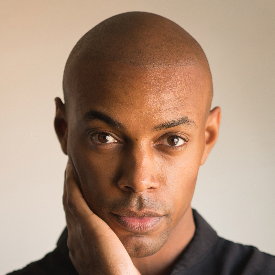
Below, Casey Gerald shares five key insights from his new book, The Great Refusal: A New Vision of Resistance.
Casey is a writer, speaker, and author of the acclaimed memoir There Will Be No Miracles Here, which was named a Best Book of 2018 by NPR and the New York Times. A graduate of Yale and Harvard Business School, he previously co-founded MBAs Across America, and his TED Talks have been viewed more than four million times. His essays and profiles have appeared in New York Magazine and Texas Monthly.
What’s the Big Idea?
Refusal is not simply saying no. It is a way of saying yes to what matters most. By walking away from what diminishes us, remembering who we are, getting more creative about how we resist, and finding joy and community along the way, we can reclaim our lives and begin building the world we actually want.
Listen to the audio version of this Book Bite—read by Casey himself—in the Next Big Idea App, or buy the book.


1. Refusal is devotion.
The first time the phrase “the great refusal” appears in literature is in Dante’s Inferno. In the third canto, Virgil is hurrying Dante through the entryway of hell, past souls who never chose a side. Dante stops. He sees and recognizes a man who made, through cowardice, “the great refusal.” The earliest speculators, including Dante’s own son, identified the coward as Pope Celestine V.
Celestine had spent most of his life as a Christian hermit, fully devoted to God. But in his late 70s, he became the compromise choice of a deadlocked College of Cardinals, and since no one turns down the job of pope, he became pope. But soon, he became convinced that the papacy was putting his soul at risk. He needed out. Since no pope had ever voluntarily resigned, Celestine was advised to pass a new law granting himself official permission to quit—and the next day, he did. He swapped his papal garments for his simple hermit clothes. He even went back to his birth name, Peter. His successor, Pope Boniface VIII, repaid him with a prison cell. But as Professor George Ferzoco told me, when Peter arrived at prison, supposedly he said, “I left the papacy so I could live in solitude. Here, I can live in solitude.” He had found his way back to his God, even if the reunion happened behind bars.
Dante’s version paints Celestine as a coward. But 50 years later, Petrarch told the story differently. Underneath the official story may be the story that sets you free. Celestine didn’t quit out of weakness. He quit to be devoted to what mattered most. In doing so, he shows us that refusal is not rejection or simply giving up. On the other side of no, there is a yes. Our refusals carry more than critique. They carry a vision of the life and world we actually want.
2. A dead end can be a doorway.
In 2021, the gymnast Simone Biles exemplified a very different kind of refusal when she suddenly withdrew from the Tokyo Olympics. Up until that moment, Simone had been unstoppable. A gymnast since the age of six, training twice a day, six days a week, through the isolation that great feats both require and produce. Then in Tokyo she was struck by “the twisties,” a life-threatening sensation of being lost in the air with no idea how or where she would land. Citing mental health concerns, she withdrew.
She had feared that Americans would hate her for letting the country down. Sure enough, she was criticized. But her withdrawal also allowed a new Simone to emerge—one who had been trying to surface for some time. She later revealed that she had long wanted to quit, especially during the excruciating years that she and other gymnasts had suffered abuse at the hands of a USA Gymnastics team doctor. Through it all, she stayed on the mat, on the beam, on the vault, in the air—until in Tokyo, her body finally said, enough.
“Sometimes the task is not to fight, but simply to let go.”
Sometimes the defiant, I won’t, is really a defeated, I can’t. Simone’s twisties proved to be not a doom-bearing nervous breakdown, but something closer to what Stan and Christina Grof would call a spiritual emergency. A crisis, yes, but also an emergence. Sometimes the task is not to fight, but simply to let go. Not great refusal, but great surrender.
Simone emerged with a new understanding that her value came from somewhere deeper than any medal. She returned, won again, but the victory was more than gold. She won herself. She won a testimony for everyone who needs to be reminded that we have more to gain than a brass ring, and less to lose than we may fear.
3. Remember who you are.
During COVID, I started working with a new therapist who also happened to be an ordained rabbi and former tarot card reader. His name was Robert, and in our first session I told him, “I’m having a really hard time.” Robert replied, very seriously: “Casey is having a hard time.” I thought he had to be kidding. Then Robert asked: “Have you ever driven a car?” Sure. “At any time while you were driving, did you become the car?” Of course not. “That’s how I want you to think about your life,” Robert said. “Casey is the vehicle. You—your soul—is the driver.”
They say we have souls, but the truth Robert suggested is that we are souls. This reflects ancient wisdom found across traditions going back thousands of years. And yet we occupy a sliver of the planet, a brief historic moment, in which serious people take seriously the notion that this thing we call the world is all the world there is. It isn’t. We are undoubtedly flesh and blood and bone, but that’s not all we are. The only revolution I’m concerned with is a mass remembering of who we really are and why we’ve come. When we remember, we regain access to our own inner knowing. We reconnect to an inexhaustible source of renewal. We refuse to keep on fighting while carrying our whole soul tied behind our back.
4. Study a different kind of war.
When people think about refusal, they often think of Bartleby the Scrivener, who stopped working and said, “I would prefer not to.” I want you to think instead about Odysseus, specifically one scene in Homer’s Odyssey.
“The goal, of course, is not simply to fight. It’s to win.”
Odysseus and 12 of his best men enter a Cyclops’s cave seeking help. They find horror instead. The Cyclops traps them and begins eating two men at a time, night after night, until only Odysseus and two others remain. He looks doomed, but Odysseus has a plan. He offers the Cyclops wine. The monster drinks, demands more, then asks Odysseus his name in exchange for a gift. “Nobody,” Odysseus tells him. The Cyclops reveals his gift: Odysseus will be eaten last. While the monster sleeps, Odysseus heats a wooden beam over a fire, and he and his two remaining men ram it into the Cyclops’s eye. The Cyclops crashes awake, hollering for help, and his buddies hurry over: “What happened? Who has done this to you?” He cries out: “Nobody is killing me.” They take him literally and go back to bed. In the confusion, Odysseus and his comrades escape.
Growing up, we often sang a song in church: I ain’t gonna study war no more. I’ve come to think we ought to study a different kind of war—the kind of tactics Odysseus used to stay alive and get back home. Not all of his tactics, of course, but those of us who would do good must be as ruthless, as cunning, as creative as those we fear are doing bad. We can look for strategies not only in Walden Pond, but in Sun Tzu, in the trickster tradition, in the hush arbors and maroon colonies of the enslaved, in the poetry of Soviet dissidents—sneaky misdirections, coordinated self-defense, even withdrawal, not as an end goal, but as a tactic. The goal, of course, is not simply to fight. It’s to win.
5. If you want to change the world, throw a party.
By the summer of 1995, the drummer Questlove and his band, The Roots, were two years into a self-imposed exile in London, still struggling to make it. Their manager, Rich Nichols, convinced them to go back home. The band would, in his words, “grow their own crops” by hosting jam sessions, and that would give them the traction they needed. He said it would take them four years. It took much less than that.
Back in Philadelphia, the band began hosting sessions in their living room. By early 1996, The Roots had landed a big show at the House of Blues in Los Angeles, where a seed of collaboration was planted between Questlove and a young artist in the crowd named D’Angelo. Questlove and D’Angelo started hanging out at Electric Lady Studios. D’Angelo owed his label a sophomore album, but there was time for that. For many nights, the most important thing was just to jam. They made covers of their favorite songs. They invited other young musicians to experiment with strange new sounds. They kept recording even when it seemed nothing was happening. The surplus was the substance. The detour was the way.
“Obligation isn’t always the best fuel for a hard journey.”
Out of those hangs came a classic album, D’Angelo’s Voodoo. And not just that, Erykah Badu’s Mama’s Gun and Common’s Like Water for Chocolate. Out of those hangs came a collective, the Soulquarians, that still inspires folks today. As Badu told me of those years: “There was no template. We were a template.”
They offer us a template now. Despite our present troubles, I believe a great unfolding is underway, and all the clues for what’s to come are planted in the people. We need each other’s clues. We can’t win the lives and world we want alone, and we can’t win through struggle and resistance only. Obligation isn’t always the best fuel for a hard journey. So keep in mind the image of a dinner party: I can’t bring everything. You can’t bring everything, but you can bring a dish. You can do your part, large or small, to make something good happen—and have a little fun along the way.
Enjoy our full library of Book Bites—read by the authors!—in the Next Big Idea App: