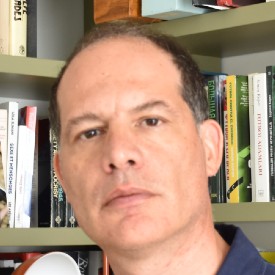











Below, Kevin Ashton shares five key insights from his new book, The Story of Stories: The Million-Year History of a Uniquely Human Art.
Kevin is a visionary technologist who coined the term “Internet of Things” and led research at MIT that helped create the system in your smartphone. At MIT, he co-founded and led the Auto-ID Center.
What’s the big idea?
Storytelling is not just a cultural force, but biologically wired into us. Every new technology that expands the reach of our stories—from fire to smartphones—sparks social revolutions. How we evolve next will determine if humanity can handle our latest ability: the power for every person to broadcast stories to everyone.
Listen to the audio version of this Book Bite—read by Kevin himself—in the Next Big Idea App, or buy the book.

1. Stories created language.
Everyone assumes language gave us the ability to tell stories, but that’s backwards. A million years ago, around night-fires in East Africa, our ancestors needed to communicate about things that weren’t immediately present—memories, plans, warnings about distant dangers. During the day, they just pointed and hollered like other animals. But nighttime around the fire was different. There were no immediate practical matters to discuss, so they did something no creature had done before: they communicated about events, remembered and imagined.
This form of storytelling required more nuance than hunting-and-gathering signals, so over hundreds of thousands of years, human vocalization evolved. Grunts and yelps turned into complex sounds about subjects acting on objects—what we now call language.
The proof is everywhere. We understand stories without words all the time: in mime, dance, photography, silent films, even when we watch strangers through a window. Every one of our seven thousand languages has the same basic structure—subject, verb, object—which is simply describing someone doing something. That’s an event, which is a piece of a story.
We’re not just a species that tells stories. We’re a species whose brains literally evolved to be story-shaped. Storytelling didn’t just change human culture—it created the human mind. We are all born storytellers. None of us can spend a waking day without seeking and sharing stories. The first purpose of language is story.
2. Every new storytelling tool causes a social revolution.
Whenever a new technology allows more people to tell stories to larger audiences, revolution follows. It’s predictable. It’s inevitable. Fire brought tribes together for the first spoken stories. Writing spread stories beyond their tellers. Printing caused the Protestant Reformation and multiple political revolutions. Radio and television transformed the 20th century. And now? Smartphones have put broadcast power into everyone’s pocket.
“For the first time ever, everyone can tell stories to everyone.”
This isn’t about the technology itself; it’s about the mathematics of stories. When you increase the number of storytellers and the size of their audiences, you inevitably increase what I call “the seismicity of stories.” Some people tell stories to speak truth to power. Others tell stories so they can lie to the impotent. The turmoil we’re experiencing right now—polarization, misinformation, culture wars—isn’t a bug. It’s a feature. It’s the predictable result of the greatest storytelling revolution in human history.
For the first time ever, everyone can tell stories to everyone. For 99.9 percent of human history, the power to tell stories to more than just a few people belonged exclusively to kings, priests, tribal leaders, and elites. That exclusivity ended about 15 years ago.
Understanding this pattern helps us see that our current chaos isn’t unprecedented, it’s the conclusion of a long cycle. Our current revolution may feel painful, but more storytelling has always led to progress, even when it feels otherwise. The story of stories shows us that we’ve survived these transitions before, and we will again.
3. We are the biggest revolution stories ever caused.
Storytelling didn’t create human culture—it created the human species itself. Our ancestor species, Homo erectus, evolved around those night-fires into creatures adapted anatomically, behaviorally, intellectually, socially, and psychologically to be storytellers. We became Homo sapiens, but we’re also Homo narrator, the species of stories.
Think about the evolutionary pressure. Individuals in groups made more cooperative by stories survived better than individuals in story-less groups. Good storytellers gained higher social status and attracted more mates. Storytelling built social bonds far more efficiently than primate grooming—you can tell stories to many people at once; you can share reputations about people who aren’t present; you can instill common values through repetition of group history.
This means storytelling is not cultural, it’s biological. Every human being is born as a storyteller. It’s as essential to being human as having opposable thumbs or walking upright.
“We still tell most stories by speaking face-to-face.”
Even now, in the age of smartphones, oral storytelling remains our primary form. We still tell most stories by speaking face-to-face. Our major oral forms include presentations, sales pitches, sermons, stand-up comedy, and the most common of all: conversation. Standard conversation is just collaborative storytelling in which two or more people take turns narrating connected events, usually in chronological order.
From the moment we wake up, we’re narrating our lives to ourselves. We tell stories about what we’ll do, interpret the world through story, make sense of strangers through imagined narratives. We think in stories because our brains evolved that way. We are the species with story-shaped brains, and storytelling is as fundamental to human existence as breathing.
4. The smartphone is the culmination of a 100,000-year pattern.
I helped invent the Internet of Things, which is a big part of the system in your smartphone. I can’t take much credit for the smartphone itself; tens of thousands of people invented it. But I can take some of the blame for its consequences.
Fire brought dozens together around a single storyteller. Writing reached thousands. Printing reached millions. Radio reached tens of millions. Television reached hundreds of millions. But the smartphone? It does more than reach billions. It reaches everyone. 7.5 billion people have smartphones now. That’s 90 percent of the human race. After forty thousand generations of storytelling, we now have a technology that allows everyone to tell stories to everyone, not just passively receive them, but actively broadcast them.
Think about what this means. For a million years, storytelling power was concentrated. You needed to be a king, a priest, a publisher, a network executive. Now? A teenager in their bedroom can reach orders of magnitude more people than a medieval monarch could in their lifetime.
This is both wonderful and terrifying. As someone who helped bring this technology into the world, I felt responsible for understanding not just how it functions, but also how it works historically, sociologically, and psychologically. What have we unleashed?
“A teenager in their bedroom can reach orders of magnitude more people than a medieval monarch could in their lifetime.”
When you see smartphones as part of this million-year pattern rather than as an isolated invention, everything changes. The anxiety, addiction, misinformation, and polarization aren’t accidents. They’re inevitable symptoms of a storytelling revolution that is as significant as the invention of writing or printing. We’ve reached the apex of a pattern that began when our ancestors first sat around fires. Everyone can now tell stories to everyone. And we’re the first people living through the consequences.
5. Critical literacy is our only defense.
We’re about to enter an age where artificial intelligence can create perfect simulations of reality at the touch of a button. Moving three-dimensional images on screens with higher resolutions than our eyes that don’t just look and sound real but will eventually smell, taste, and feel real. When signals and stimuli become literally indistinguishable from reality, when there are no tells showing us what’s actual versus artificial, the war of stories will become multidimensional.
The obvious solution is critical literacy education—teaching people from kindergarten through graduation how to evaluate sources, understand bias, and recognize manipulation. But throughout history, powerful people have fought for less mass literacy, not more, by limiting education, by censoring ideas, by banning books. The oppression of stories and storytellers is not ancient history: we see it all around us today.
No one else is coming to save us. We must save ourselves. That means becoming more self-aware, engaging in more self-reflection, feeling more doubt and humility than ever before, and understanding the innate, fundamental influence stories have on how we think and what we do.
But our uniqueness is our power. We must know that we think in stories, and we always will. Once we accept that stories shape our perception of reality, we can finally think critically about the stories we’re told and the ones we tell ourselves. This is the story of stories: it’s not just about understanding our past. It’s about surviving our future. We evolved to be storytellers. Now we must evolve to be critical consumers of stories too.
Enjoy our full library of Book Bites—read by the authors!—in the Next Big Idea App: