












What if everything you think you know about your own mind is only part of the story? In A World Appears, our Season 29 selection, Michael Pollan unpacks 10 surprising facts that will change how you see consciousness—and yourself.


1. The paradox of studying consciousness.
To investigate consciousness scientifically, we use consciousness itself—our own subjective experience and our ability to observe others. It’s like trying to see your own eyes without a mirror. We’re using the thing we want to understand as the tool for understanding it.
2. The narrator in your head.
One striking feature of thought is its often-linguistic character. Many of us experience a running internal monologue—a voice narrating our experience, commenting on it, planning what to do next. But here’s a puzzle: Who is speaking, and who is listening? If there’s only one “you,” why does it feel like a conversation?
3. Controlled vs. spontaneous thought.
We can sometimes direct our thinking deliberately—working through a math problem, planning a project. But much of the time, thoughts simply arrive, unbidden. You don’t decide to suddenly remember a childhood friend or to have a random song stuck in your head. Thoughts appear in consciousness as if from nowhere.
4. Consider the lobster.
Modern science is making steady progress in overcoming its anthropocentrism and, in the last few years, has granted sentience to all kinds of creatures. Recent beneficiaries of this newfound generosity have included lobsters, some insects, and even unicellular organisms, though these cases remain controversial.
5. Plants can learn and form memories.
Mimosa pudica, a tropical plant, instantly folds its leaves when touched to protect itself from being eaten. It can be taught to ignore a stressor (its pot being dropped) that would normally trigger it to react, and it can remember what it has learned for more than twenty-eight days. (By comparison, a fruit fly can remember something it was taught only twenty-four hours).
6. The “dirty windshield” effect.
Michael Pollan compares consciousness to a windshield we usually look through, not at. Most of the time, it’s invisible—we’re focused on the world beyond it. But alter your state with psychedelics, meditation, or deliberate attention, and the glass itself comes into view. Suddenly, you notice the smudges, the distortions, the fact that there’s a pane there at all. Consciousness, normally transparent, becomes an object of awareness.
7. Newborns and consciousness.
Today, most scientists agree that infants—even newborns—are conscious, despite being unable to describe their mental states. That consensus is surprisingly recent. As late as the 1980s, some surgeons operated on babies without anesthesia, assuming that because infants couldn’t report pain, they didn’t truly experience it. The reversal of that belief marks a profound shift in how science understands consciousness—and who gets counted as having it.
8. Panpsychism, in a nutshell.
Panpsychism is the idea that mind isn’t limited to brains. Instead, every grain of sand, every drop of ink, every particle of matter or energy carries the faintest flicker of psyche. These tiny sparks of awareness, however minimal, somehow combine to create the rich inner lives of complex beings like us. In other words, consciousness doesn’t suddenly appear at a certain level of complexity; it’s woven into the fabric of reality from the start.
9. Do plants feel pain?
When plants are injured or under stress, they release ethylene—an anesthetic-like chemical—somewhat akin to how humans produce endorphins after getting hurt. So…are they suffering? Not exactly. Plant scientist Stefano Mancuso argues that pain, as we understand it, is tied to movement: you touch a hot stove, you yank your hand away. Pain evolved to help mobile creatures escape danger. Plants, rooted in place, can’t do that. They can sense damage—say, when an animal is nibbling their leaves—but actually feeling pain wouldn’t improve their odds of survival. Awareness, yes. Agony, no.
10. In praise of mind-wandering.
Spontaneous thought may look unproductive, but it’s one of creativity’s great engines. The Oxford Handbook of Spontaneous Thought notes that many towering figures—Darwin, Beethoven, Dalí, even Raymond Chandler—worked surprisingly short days, often just four or five focused hours. The rest of their time? Long walks, afternoon naps, unstructured afternoons, extended vacations. Inspiration, it turns out, often arrives when we step away from the desk and let the mind (and body) roam.
The Key Ideas in 15 Minutes
“If you are going to get anywhere in life, you have to read a lot of books,” Roald Dahl once famously said. The only trouble is, reading even one book from cover to cover takes hours—and you may not have many hours to spare.
But imagine for a moment: What if you could read a groundbreaking new book every day? Or even better, what if you could invite a world-renowned thinker into your earbuds, where they personally describe the 5 key takeaways from their work in just 15 minutes?
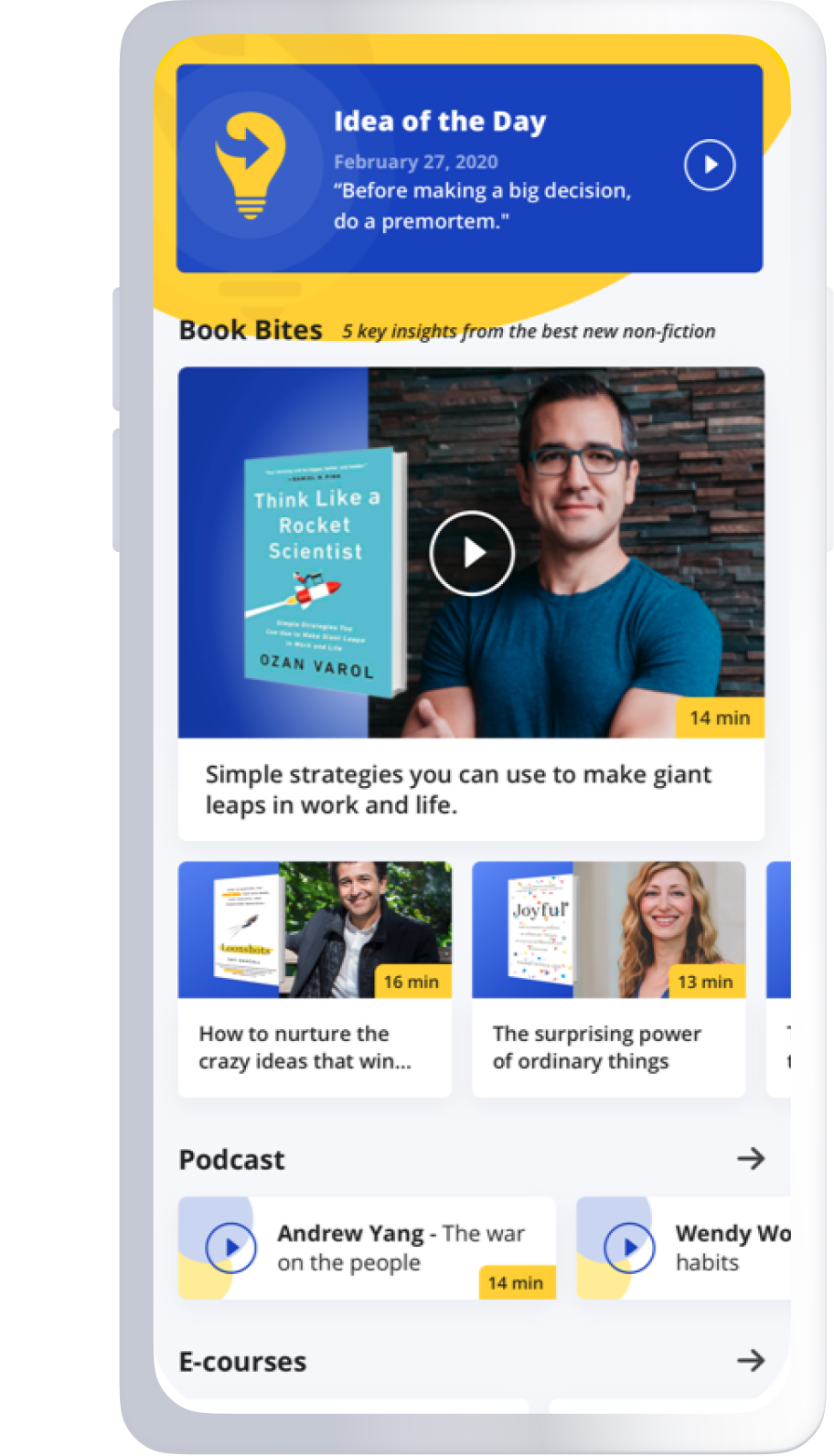
With the Next Big Idea App, we’ve turned this fantasy into a reality. We partnered with hundreds of acclaimed authors to create “Book Bites,” short audio summaries of the latest nonfiction that are prepared and read aloud by the authors themselves. Discover cutting-edge leadership skills, productivity hacks, the science of happiness and well-being, and much more—all in the time it takes to drive to work or walk the dog.


Go Deeper with a Next Big Idea Club Membership
The Next Big Idea App is free for anyone to try—and if you love it, we invite you to become an official member of the Next Big Idea Club. Membership grants you unlimited access to Book Bites and unlocks early-release, ad-free episodes of our podcast. You also gain entry to our private online discussion group, where you can talk big ideas with fellow club members and join exclusive live Q&A sessions with featured authors.


For a more focused learning experience, we recommend a Hardcover or eBook Membership. Every two months, we select a new nonfiction book as the must-reads of the season. We then send a hardcover copy straight to your doorstep, or eBook versions to your favorite digital device. We also collaborate with the authors of selected books to produce original reading guides that take you step by step through their most life-changing ideas. And yes, it’s all available through the Next Big Idea App.


Learn Faster, from the World’s Leading Thinkers
Whether you prefer to read, listen, or watch, the Next Big Idea is here to help you work smarter and live better. Wake up with an always-fresh Idea of the Day, the perfect shot of inspiration to go with your morning coffee. Then dive into one of our Challenges, hand-picked collections of Book Bites that form crash courses in subjects like communication, motivation, and career acceleration. Later, watch the playback of an interview with U.S. Surgeon General Vivek Murthy, Stanford psychologist Jennifer Eberhardt, or philosopher John Kaag. And be sure to check the “Events” tab in the app, so that you can join an upcoming live Q&A and personally chat with the next featured thought leader.
If you’re hoping to grow as a person or as a professional, we hope you’ll join us and tens of thousands of others who enjoy the Next Big Idea. Get started by downloading the app today!